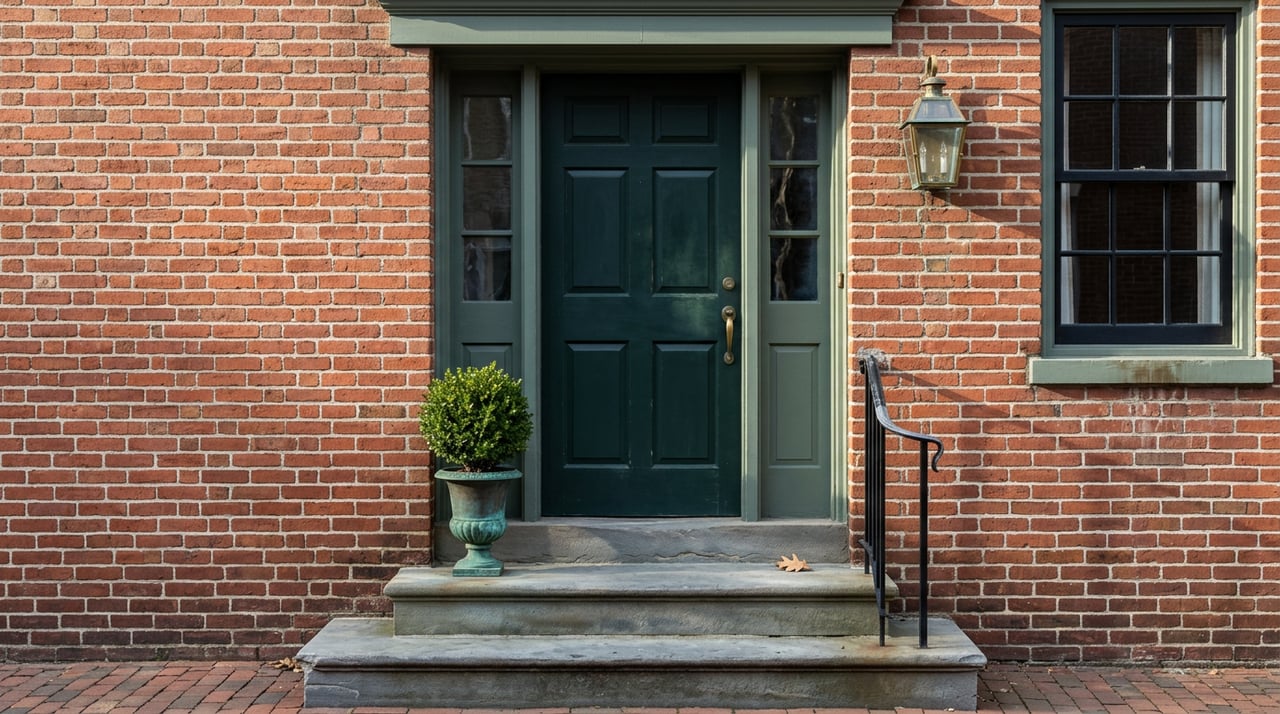
If you close on a home in Old Town Alexandria this fall, you will likely buy under one set of historic district rules and start your first renovation under another. That is not a hypothetical. The city's Board of Architectural Review is in the middle of rewriting the guidelines that govern every exterior change in the Old and Historic Alexandria District and the Parker-Gray Historic District, and the timeline lines up almost exactly with a normal Northern Virginia closing calendar.
Draft chapters were open for public comment from August 5 through September 2, 2026. City staff have said the revised guidelines are expected to go before the Board for formal adoption hearings in October. Anyone under contract right now on a historic-district property is negotiating, inspecting, and closing during the last weeks of a rulebook written in 1993, before video doorbells, EV chargers, or rooftop heat pumps existed as categories the Board had to think about.
That gap between "what the rules say today" and "what they may say by the time you pull a permit" is worth keeping in mind as you plan a renovation.
How the timing may affect buyers
Alexandria Brief reports that fourteen chapters of the new guidelines have already been adopted, covering windows, roofing, masonry, doors, fences, skylights, and solar energy systems. The eleven chapters that were open for comment through September 2, 2026 cover the things a lot of buyers actually ask about on a walkthrough: EV chargers, HVAC equipment, exterior lighting, security cameras, porches, decks, and balconies. A second batch of twelve chapters, addressing storefronts, additions, accessibility, and demolition, is scheduled for review in early 2027.
In practical terms, that means a buyer closing on an Old Town rowhouse in September 2026 is planning a spring 2027 renovation against a rulebook that will have changed twice by the time the contractor breaks ground. If your renovation wish list includes an EV charger, a security camera, or a rooftop condenser, the standard you are designing to today may not be the standard your Certificate of Appropriateness gets reviewed under.
What's actually getting easier
The draft chapters lean toward more specific, more permissive standards for exactly the upgrades most 2026 buyers want. A few of the concrete thresholds on the table:
- EV chargers sited in a side or rear yard, with no more than 48 inches of cord reach to the handle, would qualify for staff-level approval rather than a full hearing.
- Doorbell cameras smaller than one cubic foot would need no review at all.
- Porch lighting between 2,000 and 3,000 kelvin, the warm end of the color-temperature scale, would be treated as compliant without a separate sign-off.
- Sheds and other accessory structures up to 65 square feet and 8 feet tall could be approved administratively; anything larger still goes to a hearing.
- HVAC equipment visible from the street would need screening, painted to match the adjacent surface and built from wood or metal rather than vinyl, but a window unit would need no review at all.
None of this makes Old Town a free-for-all. The Board has signaled it will not typically support permanently enclosing an open porch except at the rear. But for the modern conveniences that come up in almost every buyer conversation, the guidelines are moving toward clearer, faster paths rather than case-by-case hearings.
How the districts' draft guidelines differ
The districts' draft guidelines differ in ways that may matter if you are comparing a house in the Old and Historic Alexandria District against one a few blocks over in Parker-Gray, even though both fall under "historic Alexandria."
The draft chapters differ between the districts in rooftop HVAC placement, giving Parker-Gray property owners a faster process.
| Project type | Old and Historic Alexandria District | Parker-Gray District |
|---|---|---|
| Rooftop HVAC placement | Every roof-mounted unit goes to a full Board hearing | Staff can approve units set at least 15 feet behind the front facade; only units closer to the street need a hearing |
Parker-Gray has operated under its own Residential Reference Guide up to now, and these chapters are meant to replace that guide while bringing the district closer to Old Town's framework overall. The rooftop HVAC carve-out is one place where that alignment stops short, and city staff have been asked to explain the differing treatment.
If you are weighing two comparable properties across that boundary line, this is a fair question to raise with your agent or the seller before you write an offer, not after you have already budgeted a renovation timeline around assumptions that only hold on one side of the street.
What hasn't changed, and won't
None of this touches the core mechanics that make Old Town renovations slower and pricier than a comparable project in Del Ray or Kingstowne, neither of which sit inside a locally regulated historic district.
Staff-level approvals still typically take a few days to a few weeks. Full Board hearings still run roughly four to eight weeks from submission to decision, and industry guides advise budgeting two to four months for a common exterior project once design, submission, and permitting are stacked together. Work performed without the required approval can still have consequences. Character Companies reports that unauthorized construction in the historic district is treated as a Class Two violation with fines that can climb toward $5,000 for repeated issues.
The cost premium is real too. Kitchen remodels across Alexandria generally run $38,000 to $95,000, but a historic home kitchen inside Old Town or Parker-Gray typically runs $95,000 to $175,000 or more. That gap is not decoration or finish quality. It is the direct cost of clearing a review process, whichever version of it happens to be in force when you file.
Timing it around a sale or a purchase
If you're preparing to list a historic-district home this fall, the practical move is to finish any exterior work, window repair, shutter restoration, roofing touch-up, before the new chapters go before the Board for adoption. Starting fresh after October means designing to rules that may still be in flux.
If you're buying into Old Town or Parker-Gray with a renovation already in mind, the smart sequence is to contact the city's preservation staff before you finalize a design, not after. Staff can tell you today whether your project is likely to fall under administrative approval or a full hearing, and whether that answer is expected to shift once the draft chapters are adopted. That single phone call, made before your first design sketch, is the difference between a two-week staff sign-off and a two-month hearing process you did not budget for.
A few questions worth asking before you close
Can I install an EV charger without a hearing right now, before the new rules take effect? The City of Alexandria's EV Charging Station Permit Checklist says BAR staff can already administratively approve wall-mounted EV chargers on private property in both historic districts, provided the number of charging stations does not exceed the allowed parking spaces. The draft chapters would add more specific siting rules on top of that existing path, not replace it.
What happens if a previous owner did unpermitted exterior work? Unpermitted work must be disclosed to a buyer. If you're touring a historic-district home with visible modern additions, a deck, a shed, added lighting, it's worth asking whether that work has an approved Certificate of Appropriateness on file before you assume it stays as-is.
Old Town's charm is not an accident and neither is the process that protects it. But the process is also, right now, mid-rewrite, and the version you plan around should be the one that will actually be in effect when your contractor picks up a permit, not the one that happened to be posted the day you started house hunting.
If you're weighing a listing timeline or a purchase inside either historic district and want a read on how these changes might affect your specific project, Josh Dukes and the ONE Residential team can walk through what it means for your address. Schedule a Consultation to talk through the timing before you make a move.
This article is general information, not legal, tax or financial advice. Consult a qualified professional about your situation.